




















BEHAVIOUR AND HABITS
Elephant are essentially gregarious by nature with highly developed social structures and interactions. They can be foundsingly (lone bulls), in small groups of bulls (two or three), in small family groups (ten to 20) or in large herds (50 or more).
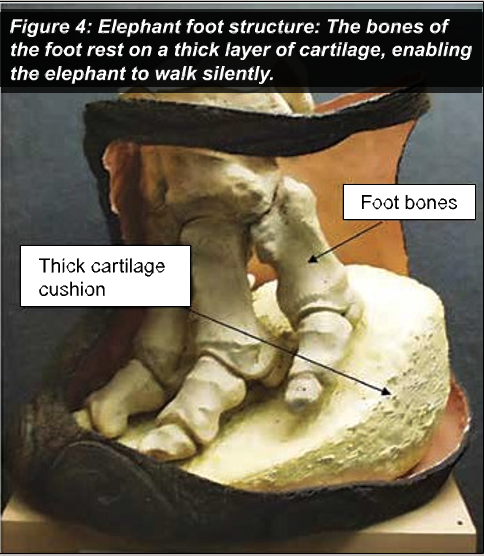
Elephant can move great distances at night or when feeding and although they can be rowdy and noisy when feeding andinteracting socially, they have the incredible capacity of moving almost soundlessly through the bush on their soft, springy feet. They generally rest in deep shade during the heat of the day. An elephant’s foot bones rest on a large pad of cartilage, enabling it to walk very quietly (Figure 4).
They sleep mostly standing upright but will, on occasion, sleep lying down or lie against some supporting structure like a termite mound. Young elephant quite often sleep on their sides. Elephant enjoy dust baths, throwing the dust over their backs and sides.
Elephant can make a variety of sounds and are generally quite vocal. They emit a very low-frequency communication rumblethat is mistakenly thought to be made by the stomach. However, this is a voluntary type of communication referred to asinfrasound (14 to 35 Hz), which enables them to communicate over a couple of kilometres. Herds of young bulls and females with calves tend to be more noisy and boisterous when on the move than herds of old bulls. If danger threatens, however, they become silent immediately and will remain so until the danger ordisturbance has passed.
Elephant have relatively poor eyesight and hearing but a very keen sense of smell. When hunting them it is therefore extremely important to stay downwind.
If left undisturbed, these grey giants are generally peaceful but when harassed their dispositions are unpredictableand they can become very dangerous. Breeding herds can be especially dangerous, as cows are highly protective of their young. Hunters should always keep this in mind. If elephant are in musth, wounded, suffering from toothache or have had previous bad experiences with humans, they can be very cantankerous and may charge without any provocation.
In thick bush they will walk in single file but will spread out and walk on a wider front in open areas. Elephant paths leading to and from favourite haunts become compacted and some are thought to be centuries old. Family groups or breeding herds are led by a dominant cow referred to as a matriarch. Bulls are not permanent members of breeding herds but come and go as cows come on heat.
A word on musth. It is an Urdu word used to describe the rutting behaviour of Asian elephant bulls. We know now that elephant come into musth as part of reproductive behaviour and also under conditions of stress.During this time bulls often show irrational and aggressive behaviour and are dangerous. During musth a sticky fluid runs out of the temporal gland, staining the sides of the face. The bull also dribbles urine from the sheathed penis onto the back of the hind legs. Musth has apowerful odour. Musth bulls will walk vast distances in search of receptive cows. High testosterone levels are found in musth bulls.
Elephant are very tactile and show remarkable social interactions and order. Young are disciplined, taught and shown great care by older animals.
These animals have a simple stomach and feed on a wide variety of plant matter. They are both browsers and grazers, grazing more in the wet months and browsing more in the dry months. Adults consume between 180 and 270 kg of food per day and drink up to 120 litres of water. They are very partial to the fruits of the marula tree but there is no truth in the often-told tale that they become drunk on the fermented fruit.
Elephant can adapt to a wide variety of habitats but are very dependent on water – not only for drinking but also for thermoregulation (cooling). During dry periods they can become extremely possessive of waterholes and will readily chase off animals of other species, as well as their own.
Musth bulls enter breeding herds to mate with receptive cows. A young calf weighing about 120 kg is born after a gestation period of 22 months. Breeding and calving can occur throughout the year but studies indicate that calving percentage is lower in bad years and higher in years of abundance
HUNTING THE SPECIES
Conservation status
The African elephant is listed by the International Union for Conservation of Nature (IUCN) as “Vulnerable”, meaning that the species is at high risk of extinction in the wild in the near future. Populations have declined from an estimated 10 million in 1900 to around 420 000 in 2014.
African elephant are on Appendix I of the Convention on International Trade in Endangered Species of Wild Fauna and Flora CITES, except for Botswana, Namibia, South Africa and Zimbabwe, whose populations are on Appendix II, subject to special annotations. Appendix I includes species that are threatened with extinction and that are or may be affected by international trade. International trade in species listed on Appendix I that is “primarily commercial” is prohibited. Appendix II includes species that, althoughnot necessarily threatened with extinction, may become so unless trade is strictly regulated. Commercial international trade in Appendix II species is permitted, but is subject to strict controls.
Cost to hunt
Prices may vary widely from country to country: Tanzania – depends on the size of the ivory. Cost ranges between $18 000and $30 000 (trophy). A 28-day safari, including elephant, lion, leopard, buffalo and plains game: $87 500.
Zimbabwe – A 10-day elephant hunt all inclusive
$31 850 – adult bull (for tusks under 50 lb). Price increases with tusk weight.
Namibia – prices range from $15 800 (6-day hunt) to
$55 760 (14-day hunt) (for tusks under 50 lb).
South Africa – bulls $40 000 and up. Not legal to hunt with bow.
Sign and tracking
- Tracks:
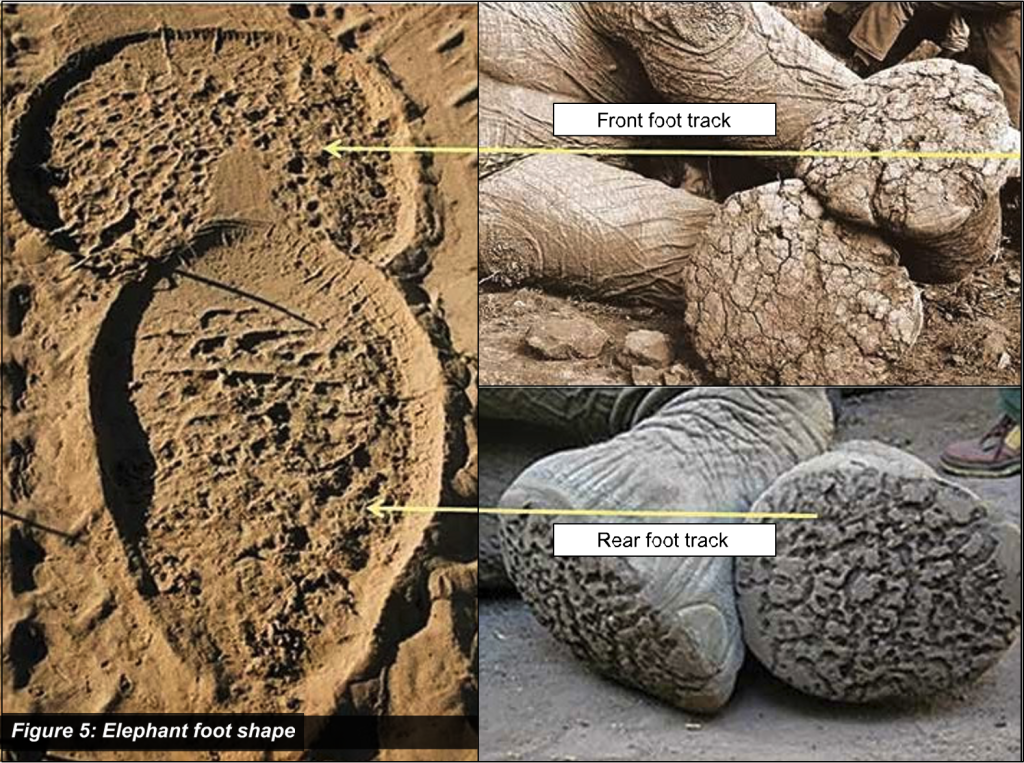
The front feet of elephant are round in shape while the rear feet are more oval-shaped. This makes it easy to differentiate between front and hind feet (Figure 5).
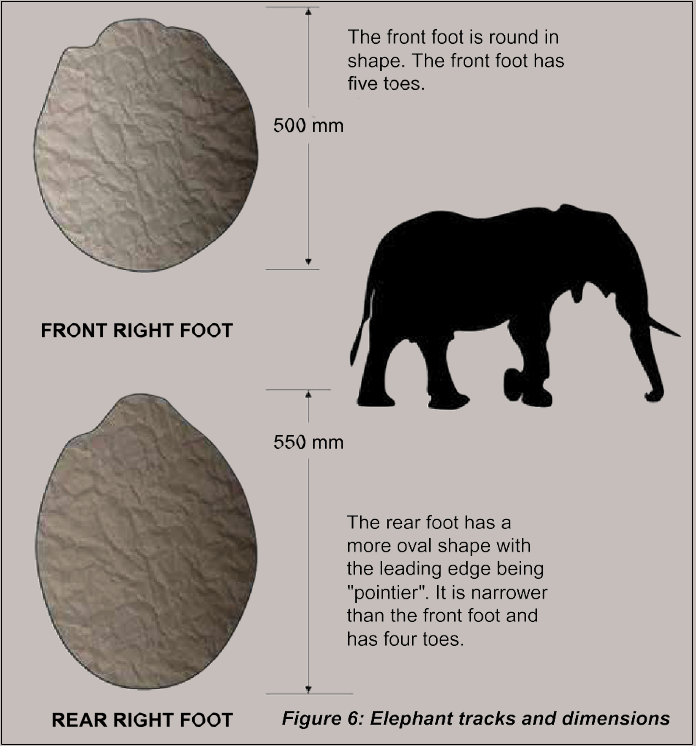
Although it is not possible to distinguish in the track, the front foot has five toes and the rear foot four. The rear foot is slightly longer than the front one (Figure 6).
Foot soles are deeplyfissured and the pattern of cracks is like an individual fingerprint, making it possible to identify individuals by their track patterns. The soles become smoother the older the elephant gets – much like the tyres of a vehicle that lose their tread as they become worn.
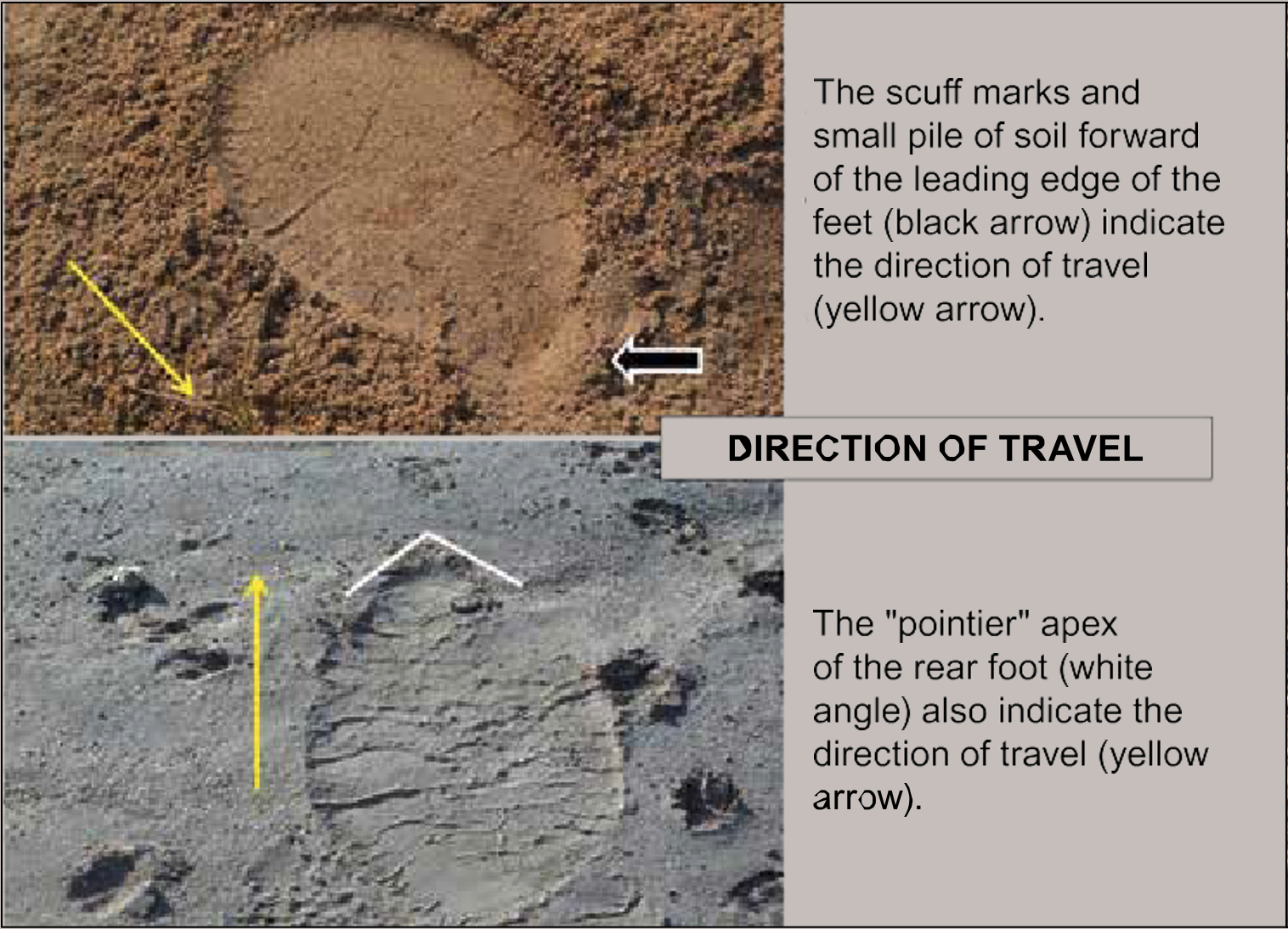
The direction of movement is indicated in soil by a scuff mark and a small pile of soil in front of the leading edge of the feet. Thepointier end of the hind foot willalso indicate the direction of travel(Figure 7). When walking on grass, not much track detail will bevisible but rounded areas of flattened grass should be present and the direction of travel will be indicated by the direction of bent grass.
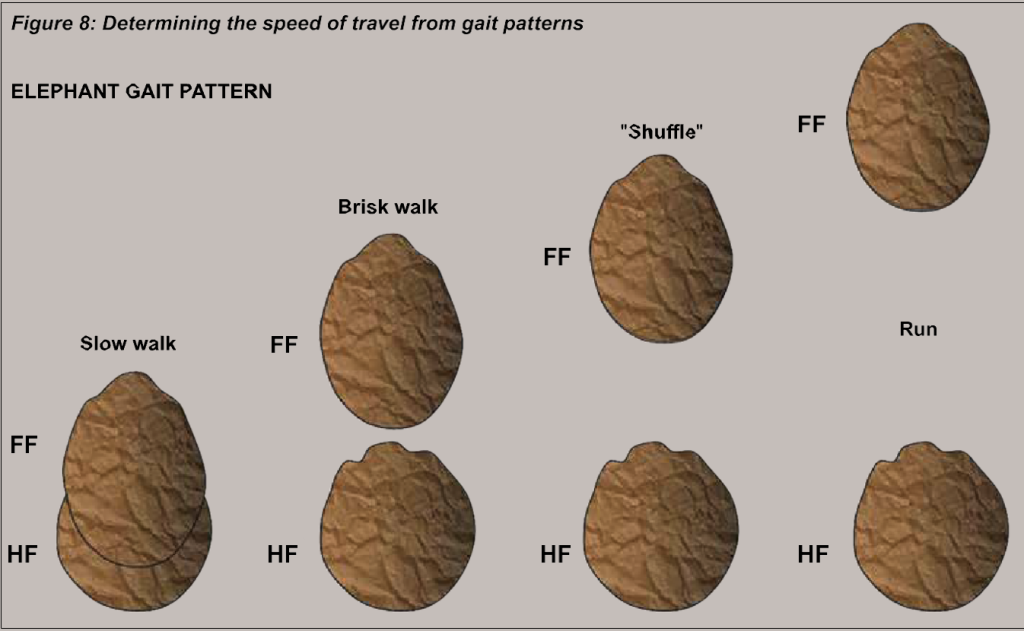
The ability of elephant to walk silently can be attributed to the structure of the foot. The foot bones rest on a thick layer of spongy cartilage that cushions the foot. When walking, the hind foot is superimposed on thatof the front foot. At a very fast walk(shuffle) or a run the hind foot andfront foot imprint separately (Figure8).
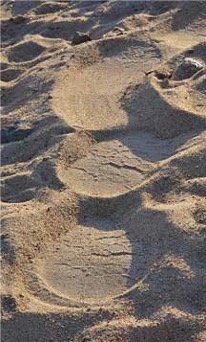
A single set of elephant tracks will usually be that of a lone bull (Figure 9).
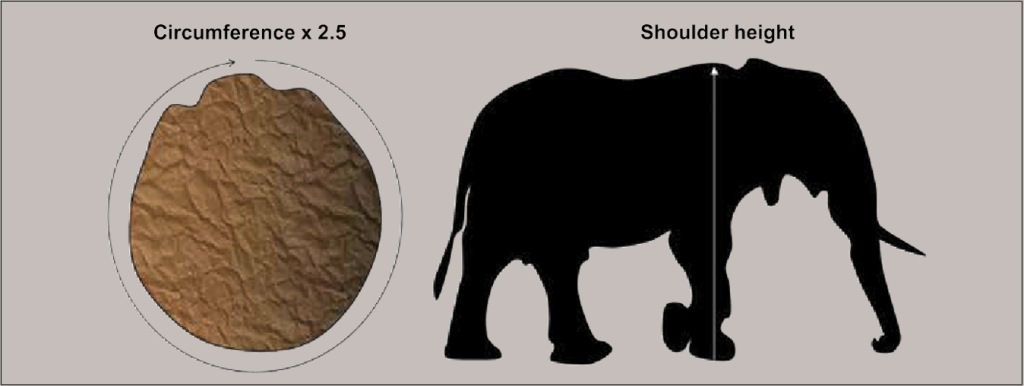
Cows and young (with attendant bulls) walk in herds where there will be a lot of tracks of different sizes. The circumference of the front foot, multiplied by a factor of 2.5, can give a good indication of the shoulder height of the elephant (Figure 10).
- Aerial spoor and smell:
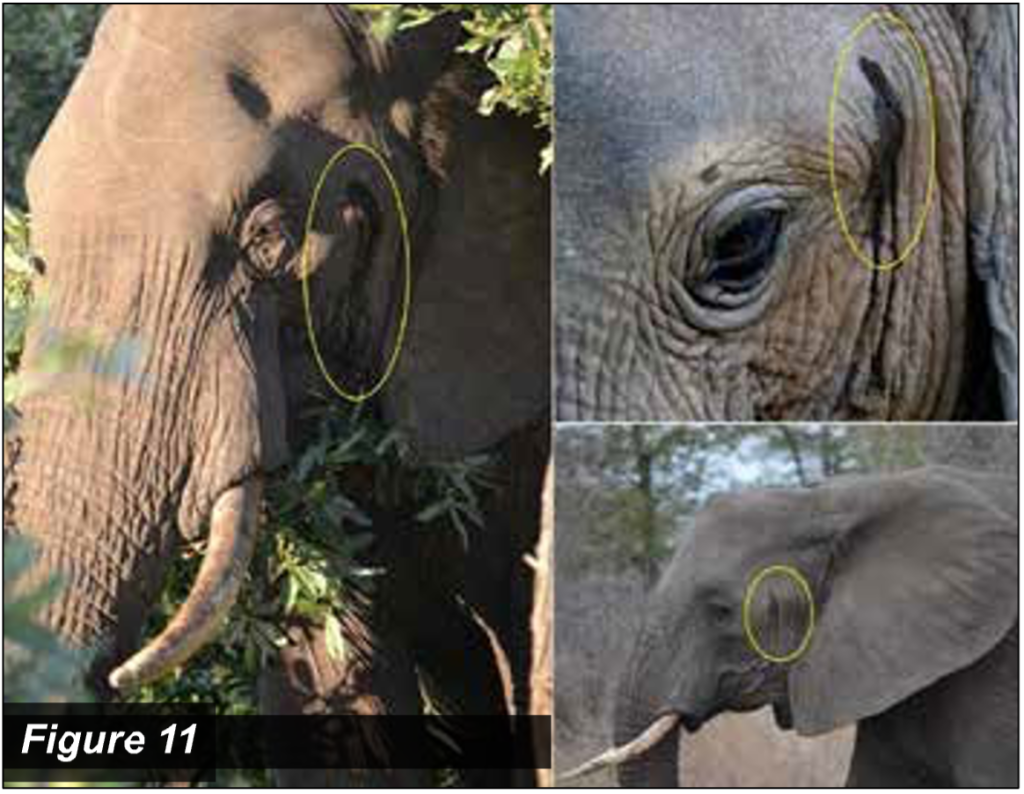
When walking through vegetation or long grass, elephant will leave an “aerial” trail of lighter-coloured vegetation that has been pushed in the direction of travel as the animal moves its huge body through the bush. The smell of musth in the bush is unmistakable if you know it and lingers long after an elephant has passed that way. I once tracked an elephant bull for about 2 km just by the smell of musth on the vegetation (Figure 11).
- Scat:
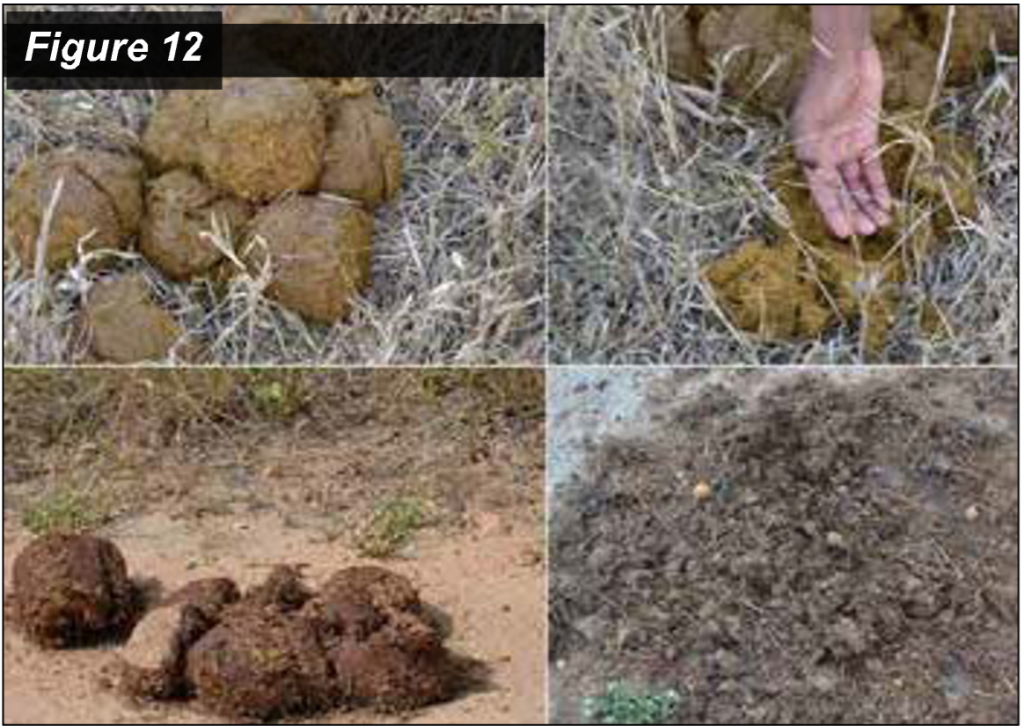
Elephant produce large quantities of scats, one of the most obvious signs to be encountered (Figure 12).
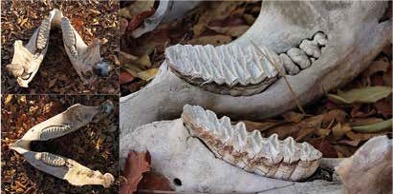
The shape is that of large, elongated cylinders, each about 14 cm in length and 12 to 14 cm in diameter. Whenfresh, the colour is a dark, olive green becoming very darkbrown with age. Fresh dung is covered with a layer ofmucus that evaporates within about half an hour on a hot day. It is coarse and consists of the remains of digested grass, twigs, leaves, bark, fruits (especially marula during February to March) and tubers, and has astrong but not unpleasant odour. As elephant age and theirlast pair of molars begin wearing down, their dung becomes more fibrous as the food cannot be chewed andground down as effectively as when they had their earlier sets of teeth.
- Feeding and drinking sign:
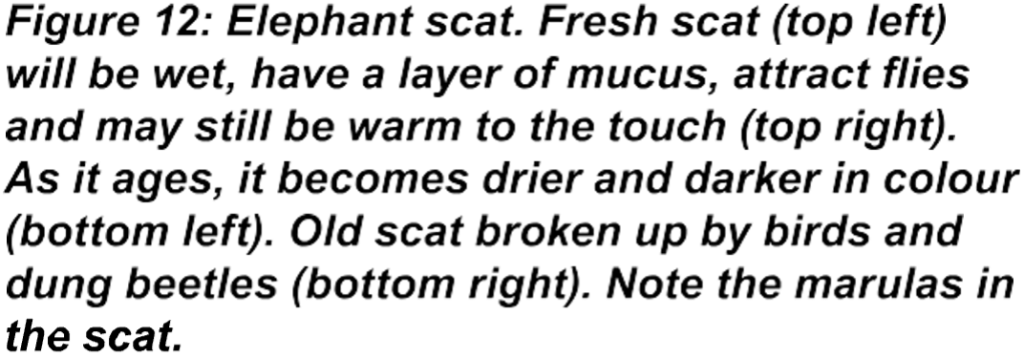
Elephant feed for up to 18 hours a day. They could be described as destructive feeders (Figure 13). They will pull up grass by the roots, break branches to get at browse or fruits, strip bark and dig up tubers with the toe or heel of the foot. They leave behind very obvious signs of feeding that are generally easy to spot. They can cause extensive damage to big trees by stripping off bark. Trees will try and repair damage with scar tissue but wood borers attack bark-denuded areas, which can eventually kill the tree.
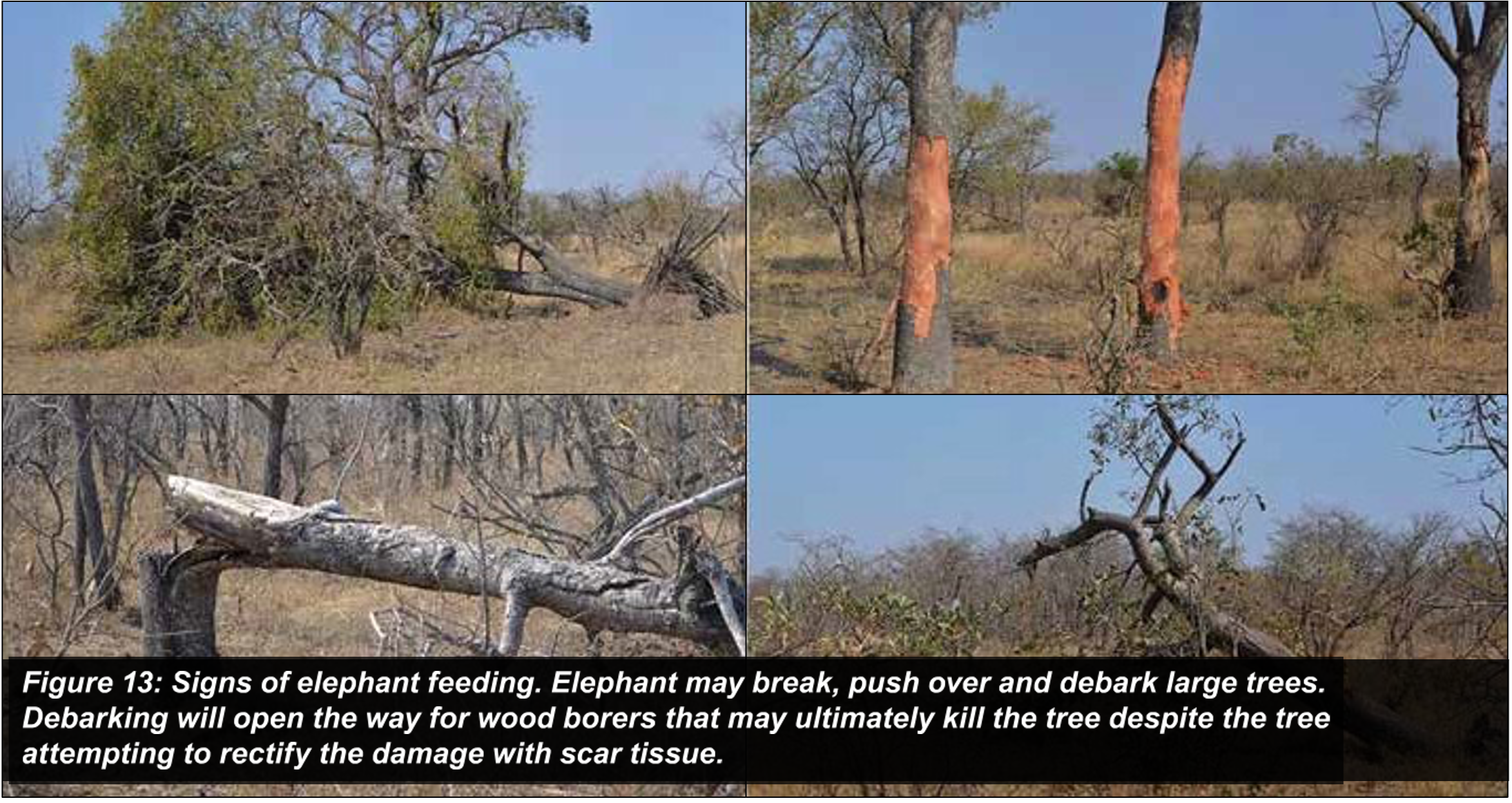
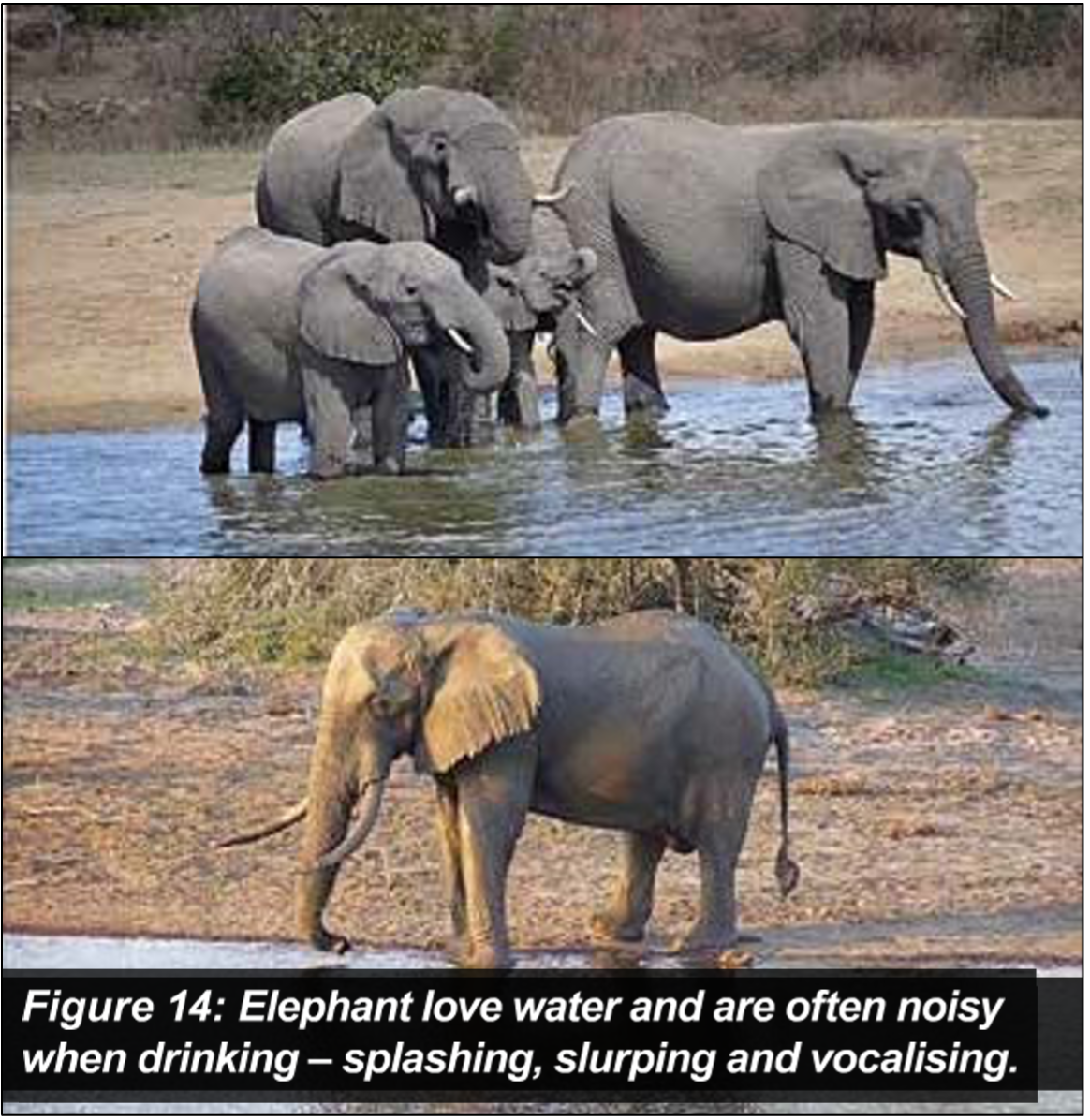
If a tree is ringbarked it will also die as it cannot transport food and nutrients. Elephant drink regularly and sign can often be found at waterholes, dams and rivers (Figure 14). The sounds of elephant bathing, squirting water, swimming or wallowing can at times be heard from a distance.
- Dust baths, wallows and rubs:
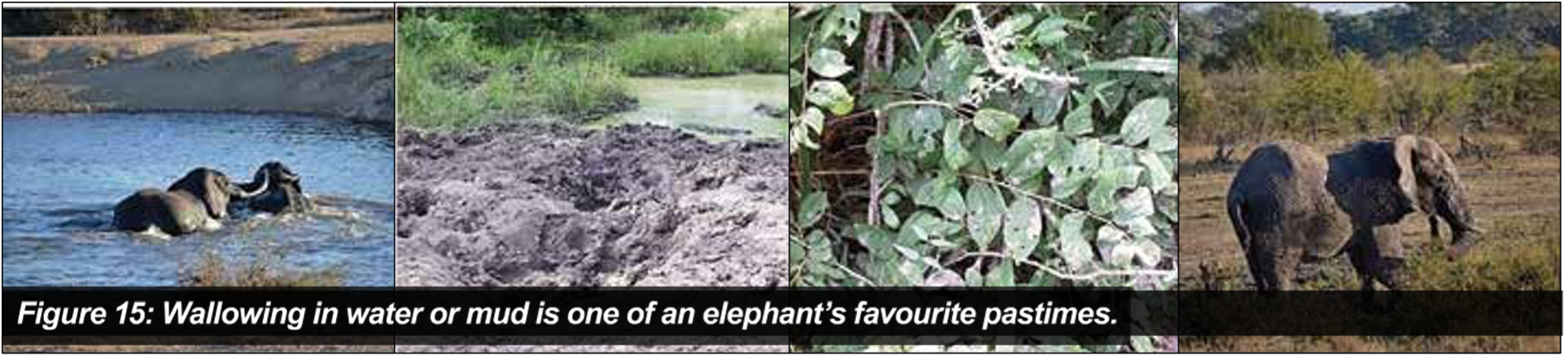
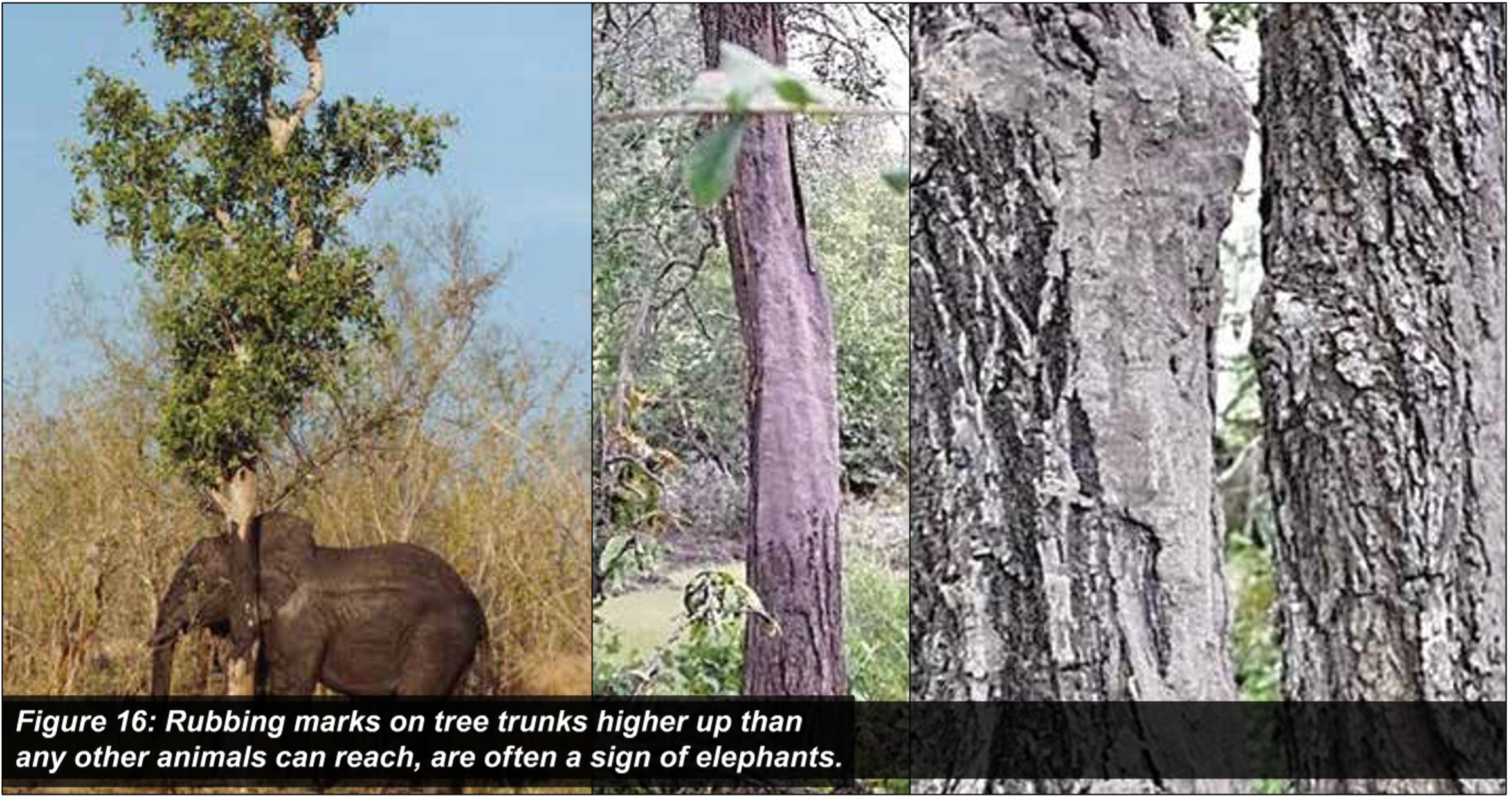
Elephant love swimming and splashing themselves withwater and mud to help control body temperature and external parasites. Mud wallows are usually churned up and splashed mud will be found on surrounding vegetation (Figure 15). They will also drop mud and wipe it on vegetation when moving away from a wallow. Large trees are also favourite rubbing posts to remove hard-baked mud or to scratch an itch (Figure 16).
- Elephant paths:
Elephant could be described as “movers and shakers” and their ability to cover vast distances across Africa is well documented. They are partial to travel well-known routes, resulting in well-compacted “elephant highways” crisscrossing thelength and breadth of their favourite haunts in Africa over the centuries.
- Digging:
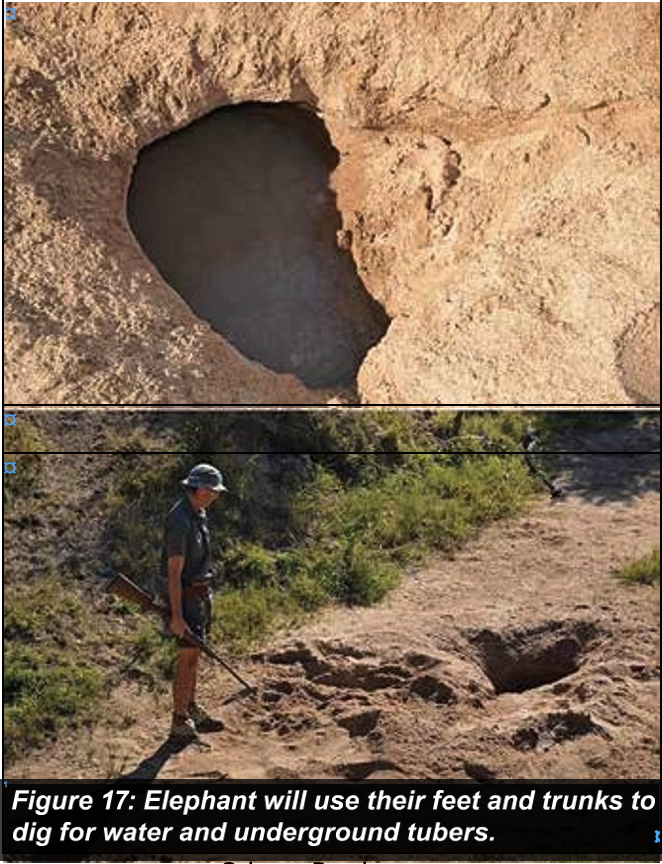
Elephant use their heels to dig for underground roots and tubers and will excavate large holes, using their feet and trunks in riverbeds in search for water – especially during dry periods when surface water becomes scarce (Figure 17).
- Social vocalising:
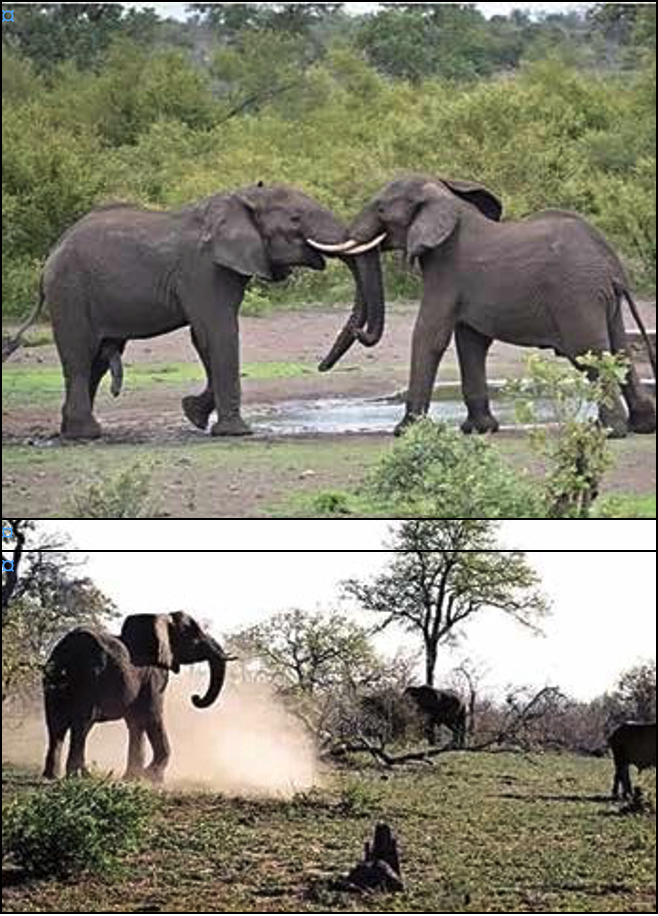
Another sign of elephant in the vicinity is their vocalising. Elephant, even when in a herd, can be very quiet – so much so thatthey can be only a few metres away without you being aware of them. This can make for a very dangerous situation if you unexpectedly come upon them. Elephant are, however, very social and vocal and will trumpet, bellow and be noisy when they need to be or want to be – sounds that carry far in the quiet of the bush. Young elephant play and squeal just like childrenand will also loudly “give voice” when they are frightened or in distress (like if they get stuck in mud). Bulls trumpet loudly when they are fighting or when chasing other animals away from a waterhole (Figure 18). Also listen for “belly rumbles”, which are in fact a range of communication sounds.
- Carcasses:
Occasionally you may come upon the carcass of an elephant or be alerted to it by vultures and other carrion feeders, such as lion and hyena. ASM
REFERENCES
Cheney, CS. 2013. The comprehensive guide to tracking. Safari Press.
Mellon, L. 1975. African hunter. Harcourt Brace Jovanovich, New York and London.
Robertson, K. 1999. The perfect shot. Safari Press. Robertson, K. 2007. Africa’s most dangerous. Safari press. http://www.huntinafrica.com/usefulinfo/rifle-bowhttp://www.scirecordbook.org/african-leopard/ http://www.huntinafrica.com/images/PDF/Cape%20to%20 Cairo%20Pricelist%202016.pdf http://www.bornfree.org.uk/animals/african-elephants/ conservation-research