












Overview of DANGEROUS-GAME hunting in Namibia
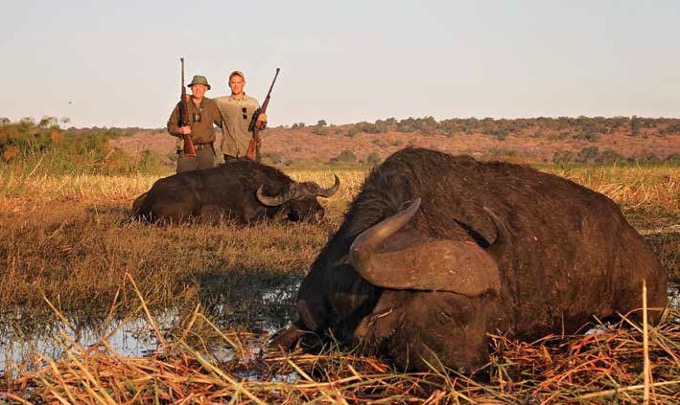
Few know that NAMIBIA is one of the best destinations forDANGEROUS-GAME hunting.
Namibia is seen as a plains-game paradise by the hunting community in general, but few know that it is one of the best destinations for dangerous-game hunting as well.
Most first-time hunters travel to Namibia to hunt plains-game on private farm land, which can be as diverse as hunting thered dunes of the Kalahari to hunting the unforgiving and harsh mountains of the Khomas Hochland. They may encounter some leopard hunting on these farms, either on that first trip or on subsequent trips. This may have created the impression that Namibia is mainly a plains-game destination, with occasional leopard as the only dangerous game available. Nothing can be further from the truth. Great elephant, buffalo, hippo and crocodile hunts are also available in Namibia on state-owned land. A few lion permits are also issued every year, but very few are on trophy hunting permits, so I will leave them out of this article.
General
To guide a hunt for any dangerous game, excluding leopard, a Namibian professional hunter needs a big-gamequalification. (Leopard hunts can be guided by any professional hunter or hunting guide on private land.) All trophy huntersmust have a trophy-hunting permit made out in their own name, and any professional hunter may only guide a maximum of two clients at any given time.
The trophy-hunting season in Namibia stretches from 1 February up to 30 November of the same year. Try and stick to hunting with an outfitter or professional hunter who is a NAPHA member, where possible.
No dangerous game may be hunted with a bow and arrow. Most of the dangerous game, except leopard, are hunted on state-owned land in the form of communal conservancies or on National Park-controlled land. In the case of communal conservancies, the Government of Namibia, through the Ministry of Environment and Tourism (MET), approves a sustainable quota for the area that the local community, through their selected management committee, can put out on tender to in-terested big–game outfitters. The Park areas are either also put out on tender or they are auctioned off. Most areas run on a three- to five-year contract between the outfitter and the community. As there are less than 20 outfitters who have their own big-game area but more than 100 professional hunters marketing it, make sure that you hunt with someone who owns an area, or at least has direct access through a sub-lease agreement.
Leopard
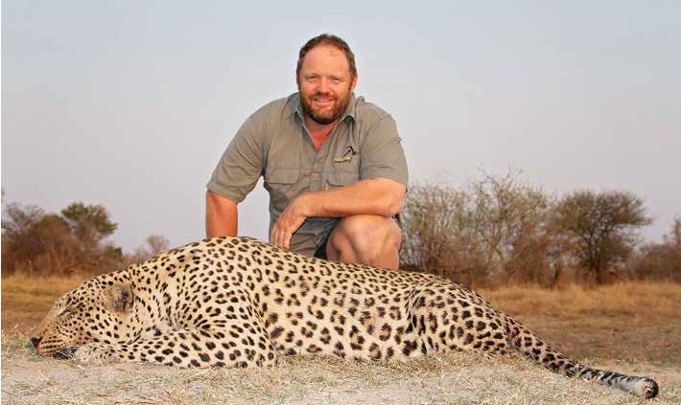
Currently, Namibia has a CITES quota of 250 leopard per year that may be hunted as trophies. As already discussed, the majority of these permits are allocated for leopard hunting on private land (around 180 to 200 permits per year). There are some great outfitters for hunting these wily cats on private land, but unfortunately there are also some outfits who have little or no experience of hunting leopard, so do your homework if you intend to hunt leopard on private land. As a rule, most of the good cats come from the central and northern parts of the country, especially from rocky areas. And alwaysremember you get what you pay for.
On state land, most of the CITES tags are allocated to communal conservancies in the northwest of Namibia,conservancies around Etosha and Khaudom National Parks, and the Caprivi and Kavango regions.
As hunting leopard with the aid of hounds was banned in Namibia at the end of 2009, all leopards are supposed to be huntedby baiting and waiting in a blind. Currently, Namibia’s legislation allows us to hunt up to 30 minutes after sunset and starthunting 30 minutes before sun up.
It is illegal to use artificial light to hunt leopard in Namibia. Trail cameras are a great help in deciding when to go and sit for a specific cat, but I prefer to sit from around two hours before sunset up to the end of the legal time in the afternoons. I try to be in the blind half an hour to one hour before legal time in the mornings, so that if the cat is still around after you are dropped off, it can settleback into feeding, giving you a chance at it as soon as you can clearly see it without artificial light. This coincides with legalshooting time for people with normal to good eyesight when using a good quality telescope.
Some other pointers:
- Make sure that your outfitter has a tag specifically for the property on which the hunt is conducted.
- Only males may be trophy
Buffalo
Buffalo are currently available to be hunted in the Zambezi region (formerly known as the Caprivi) and the Kavangoregion, as well as two smaller populations of fenced buffalo – the Waterberg Plateau Park and in a quarantine camp of approximately 10 000 ha in the Nyae Nyae Conservancy. Both these fenced populations have produced exceptional trophies in the past but my preference will always be to hunt buffalo in the unfenced areas of the Caprivi and the Kavango.
When discussing buffalo hunts in Namibia, the mental image most hunters have is of the seemingly endless floodplains of the Eastern Caprivi.
In fact, many of the buffalo hunted in Namibia are hunted on the floodplains of the Chobe River. Such hunts can be testing in the wetter months – similar to some Mozambique hunts – where the high water and the difficulty of moving around in these wet, swampy areas is the main challenge.
As these areas dry up, moving around becomes easier, and the herds of buffalo can often be spotted a long wayoff, making stalking and approaching more difficult if you really want to get close to your quarry.
A novel way of hunting buffalo and something everyone should try at least once, is what I consider a classictracking hunt for buffalo, on so-called “dry” concessions. Fortunately we do have areas in Namibia where you can do this.
On these hunts, the timeless way of looking for tracks and following your quarry into the thick bush is used.
This is my favourite way to hunt buffalo and the way we hunt most of our buffalo in our Caprivi areas. This also makes iteasier to target bachelor herds of “dagga boys”, my preferred target.
There are some other areas, more to the western part of the Caprivi, that are considered wet areas (between Mudumu and Mamilli Parks or on the Kwando river). These do not have huge flood plains. Here one needs to cross small channels to reach thickly-wooded islands to look for buffalo on foot. This may not sound appealing to many hunters but it is a veryenjoyable way of hunting buffalo.
Some Caprivi areas can be very seasonal for buffalo, so stick to hunting the wet areas later in the season and the dry areas early in the season, or after the first summer rain at the end of November. Your hunting outfitter should be able to tell you which periods during the year work best. Some areas, like the hunting blocks inside the Greater Bwabwata National Park, always have buffalo, but due to the better visibility in the drier season, the best time to hunt them would also be from June to November.
Strangely enough, buffalo is the only species mentioned in Namibia’s laws regarding a minimum legal rifle for hunting them. This minimum is not a calibre but rather an energy figure of 5 400 joules, or around 3 970 ft/lb. Notwithstanding this, please use your common sense and rather hunt buffalo with a .375 than a .338 Win Mag, which also qualifies. I reload my 9,3×64 and my .375 H&H to marginally make this standard, but with Barnes TSX, Swift A-Frames and North Fork softs they are deadly on buffalo.
Elephant
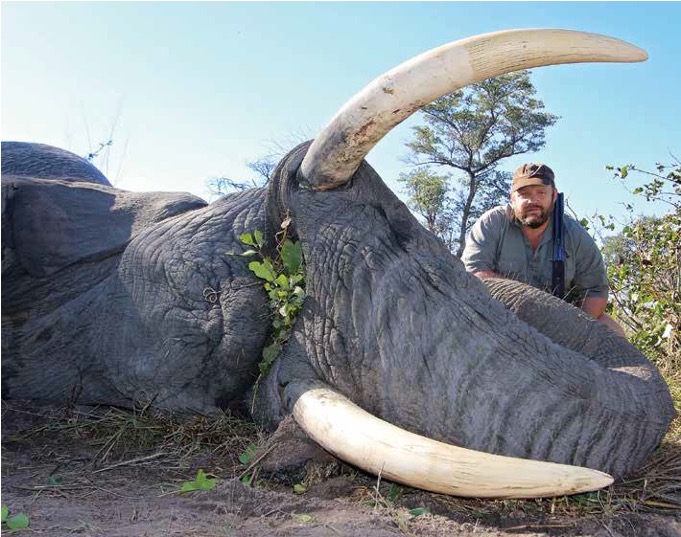
The northern part of Namibia is home to most of the country’s around 20 000 elephants. Currently Namibia has a CITESquota of 90 exportable trophies per year, of which the majority are hunted in the Caprivi and Kavango regions. A few permitsare issued every year for the more arid northwestern areas for so-called desert-adapted elephants. They are in fact no different from normal elephant; they just choose to live in the drier areas.
Most hunting concessions also get a handful of permits for own use elephant or Traditional Authority elephant, which is basically a non-export, non-trophy elephant hunted either for meat for the community or for a festival. Itis sold as a hunting experience only, and no part of the trophy can be kept by the hunter. Hunts for these elephants tend tobe about a third of the price of a trophy hunt, so they are a very affordable way of gaining experience of elephant hunting.On these hunts, you are likely to target a broken-tusked or a genetically weak bull, or sometimes an old cow.
Communal areas like Nyae Nyae Conservancy and park areas like Bwabwata East and Bwabwata West are well-known for producing exceptional ivory but these hunts are normally beyond the budget of most hunters.
For around half the money, very good trophy hunts for bulls can be had on most of the other communal conservancies.However, you are likely to find smaller ivory in these areas, mostly owing to the fact that more people are living here. The big bulls prefer to stay where there is very little or no human activity. Very occasionally, these conservancies will produce a bigger bull but a reasonable expectation would be a bull in the 40–50 pounds class. If you must have big ivory, I would recommend sticking to the areas as mentioned above.
Hunting the eastern Caprivi areas, on the floodplains of the Chobe, can generally be considered an “easy” elephant hunt, as the animals can be spotted from many miles away. These hunts are great for people that have limited walking ability.
The rest of the Caprivi and the Kavango requires a tracking hunt and would be my choice if one is fit enough. These elephant hunts will require a lot of driving and tracking, so be prepared for it. Normally, you would leave camp in the early morning to look for suitable tracks to follow. If tracks are found, you may spend anything from a few minutes to the rest of the day trying to catch up with the elephant to asses its trophy potential. This is only done at very close range, well within an elephant’s “fight” circle.
If a suitable bull is found, then the real tricky part starts – getting even closer, and in the case of it being with others, trying to isolate it for a sure shot. This uncertainty as to what you will find, the walking, seeing the trackers work and being so close and sometimes in amongst the animals, is what makes elephant by far my favourite dangerous-game animal to hunt.
There is no minimum calibre or energy figure for elephant in Namibia, but please be sensible and use something like a9,3 and up, with proper solid bullets, like any of the new brass or copper mono-metal, flat-nose bullets or Woodleigh Solids.
Hippo and crocodile
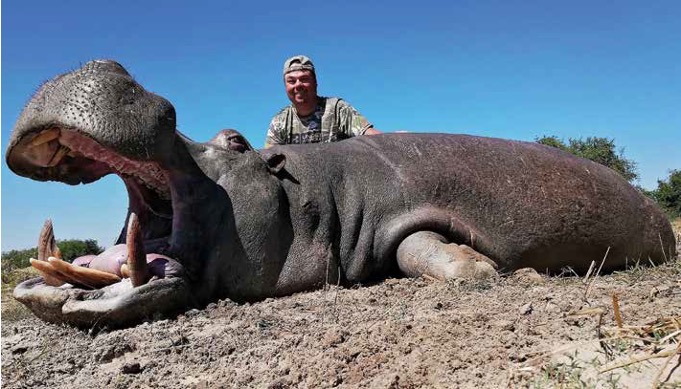
All the perennial rivers in northern Namibia hold hippo and crocodile, and most communal conservancies or park hunting areas that border on these rivers, are given an annual quota for hunting. These rivers are the Kunene, Kavango, Kwando, Chobe and the Zambezi. The Kwando / Linyanti / Chobe river system has the highest population density of hippo in Namibia. This may be due to the very high density of reeds along the Kwando river, into the Linyantiswamps and the first part of the Chobe River’s flow out of the Linyanti swamps.
Most hippo are shot in or very close to water but especially along the rivers with lots of reeds, one can also stalk them in shallow pools or on dry land close to the main river. The small flood plains of the Kavango river and the Kwando river are very good options if you want to shoot one on land.
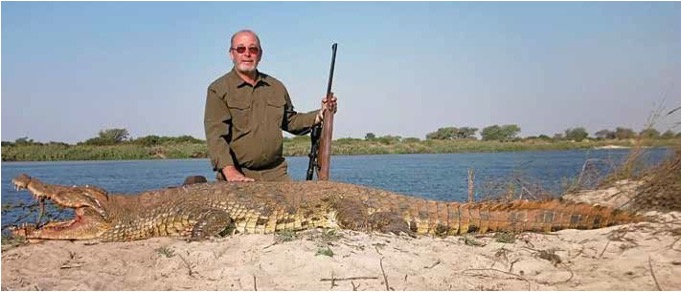
The best crocodile trophies come from the Zambezi, Kavango and Chobe rivers, arguably because these rivers tend to have more open banks and thus they are easier to bait or stalk and hunt these reptilians. Baits work well to draw and keep a crocodile to a specific spot to shoot it. However, with a bit of reconnaissance and a good knowledge of the area,favourite sunning spots can be identified and the animals stalked. Some of the best crocodile hunts I have guided were shot in this way.
Rhino
Namibia has a CITES quota of five black rhino per year, of which the Government issues between three and five permits every year. Most of these hunts are conducted on state land for bulls that have been identified as post-productive individuals. A few white rhino are also hunted every year but only on land on which they have beenroaming for more than one year. Also, these areas must be bigger than 1 000 hectares before a permit application wouldbe considered. Most white rhino hunts thus take place on private land.
Namibia may not have big quotas for dangerous-game animals, like some of our neighbours do, but what we do have, is mostly free-range, high-quality hunting. I hope this article helps to highlight Namibia as a dangerous-game hunting destination. ASM