















WHERE THE METAL MEETS THE MEAT….
What is the most important piece of equipment you will use on your African Safari to determine the success of the hunt? Will it be the calibre, the rifle itself, or your optical equipment?
I am sure one can argue that all these are equally important to achieve a certain goal (taking your intended trophy swiftly and successfully), and rightly so. However, I think there is one specific piece of equipment that determines the level of accomplishment, and that is the bullet you use.
It’s that small item that does all the work and must therefore be of top quality. In today’s world, where technology is developing faster than the consumers’ ability to keep up, we are spoilt for choice. There are numerous brands and ranges available on the market. This facilitates choosing the correct type of bullet for theintended application.
It’s important to keep in mind, however, that every bullet is designed to perform at its best at a certain velocity. Itis no use torturing a softer lead bullet with extreme velocities – it will simply break up. Also, when choosing amonolithic type of bullet, you need to achieve the velocity prescribed by the manufacturer, otherwise it will not open up enough or even open up at all, leading to total bullet failure and compromising the success of your hunt.
The point where the bullet strikes the animal is of utmost importance. This is the deciding factor, thedifference between success and failure. If your bullets are substandard, you put your whole safari at risk. Spending days tracking a wounded animal is hardly ideal, especially not for the animal. And in the case of a dangerous animal, you will be putting your own life, as well that of your PH and tracker, at risk.
In this series of articles we will be showing what happened, with real bullets recovered from real animals after ahunt. We will put the facts on the table, give credit where it is due and also highlight mistakes, weak points andfailures. This is what it is all about – where the Metal meets the Meat …
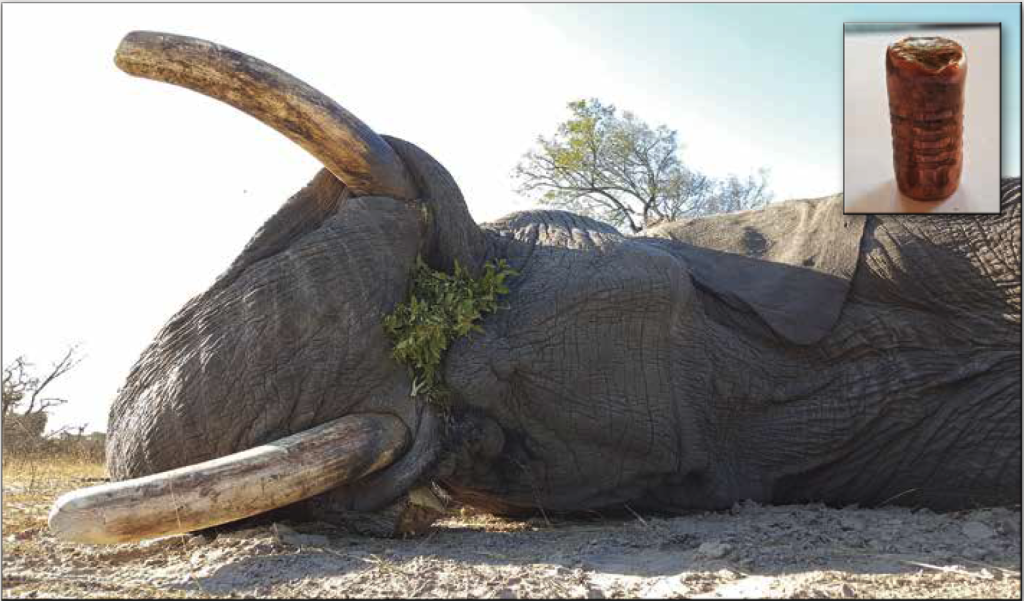
An Amerian client from Texas hunted this bull elephant together with KARL STUMPFE of Ndumo Safaris in Namibia’s Sakunga area. The bull was brought down with a good heart shot. However, the PH took an insurance shot as they could not afford the possibility of a wounded elephant escaping from the concession. The animal went down at 20 yards, with Karl using his Verney-Carron .577 NE with hand-loaded ammunition. A single 700 gr Peregrine VRG-2 (solid) at a muzzle velocity of 2 150 feet per second out of the .577 NE broke the spine of the elephant and the bullet stopped underneath the skin of the opposite shoulder. The recovered bullet weighed in at 100% of the original 700 gr and no deformation took place.
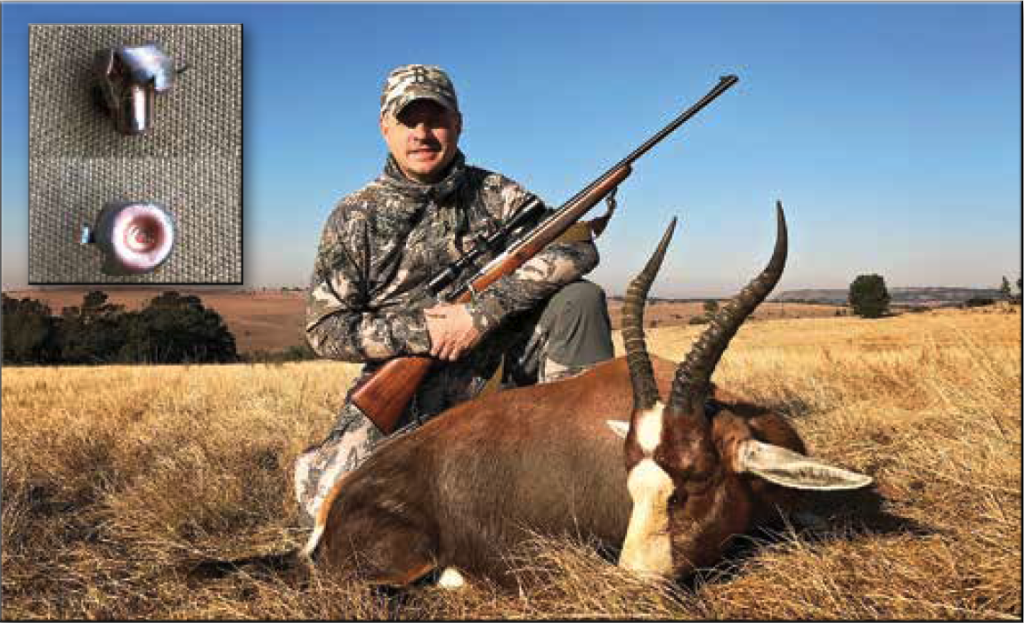
United States client,
MIKE LAPPI, hunted this blesbuck with PH Dewald van der Walt and outfitter Robert Stannard in the Utrecht area of KwaZulu-Natal in South Africa.Mike used a FN 7×57 Mauser loaded with 160 gr Nosler Partitions at 2400 feet per second. He took a frontal shot from 150 m away and the bullet penetrated the entire length of the animal and was foundlater underneath the skin on its backside. Weight retention was 104 gr, or 65% of the original weight.
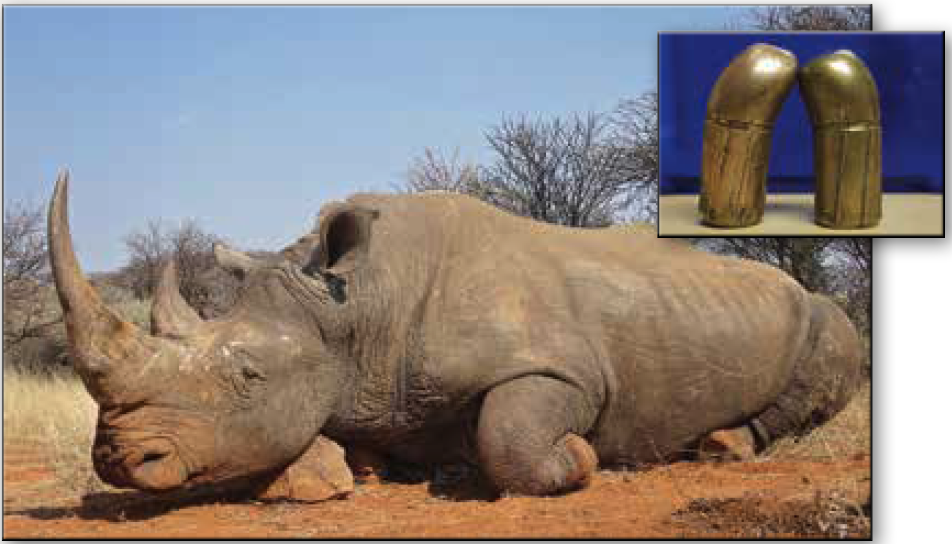
A rhino hunted with CHOICE SAFARIS in South Africa by a Russian client. The rhino was hit just before dark and the choice was made that the PH would shoot backup shots. Both shots from the .470 NE were fired into the hip of the running rhino and put the bulldown in its tracks. The ammo used was factory loaded, with 500 gr Woodleigh projectiles. Shooting distance was 40 m. Both bullets were recovered from the hip bones and both took seriouspunishment. Although a bit malformed, both bullets stayed intact, with 98% and 100% weight retention respectively.
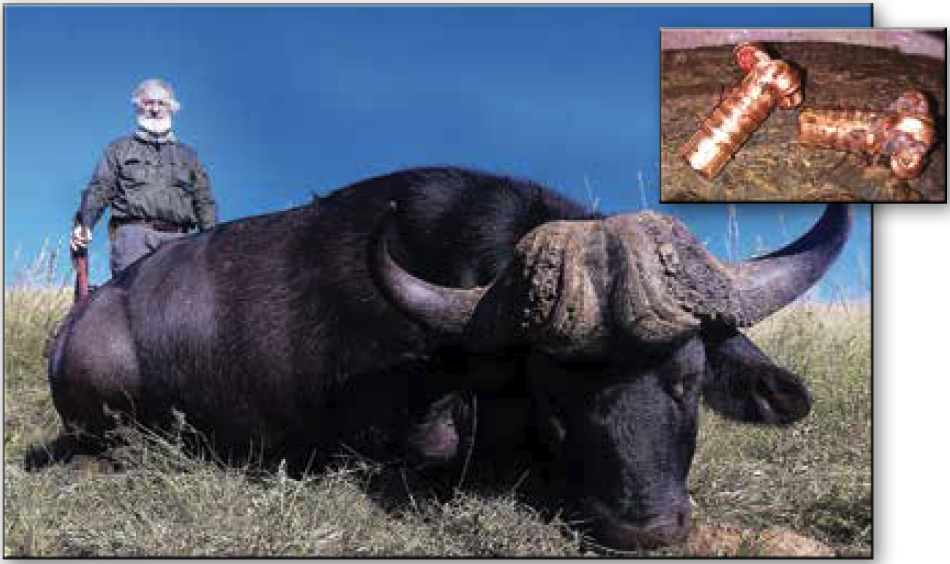
JAMES GARRITY hunted this buffalobull with WOW Africa Safaris near Louwsburg in the KwaZulu-NatalProvince of South Africa. He used a.375 H&H with hand-loaded ammunition. The bullet of choice was a 300 gr Barnes TSX, leaving the barrel of the gun at 2 400 feet per second. The bull was standing broadside at a distance of 40 yards. A perfect shot through the vitals ensured a clean killand the bull was down within 30 yards.Without knowing the result of the first shot, the client fired a backup shot. Both bullets were recovered and both weighed in at 285+ grains, close to 100% retention.
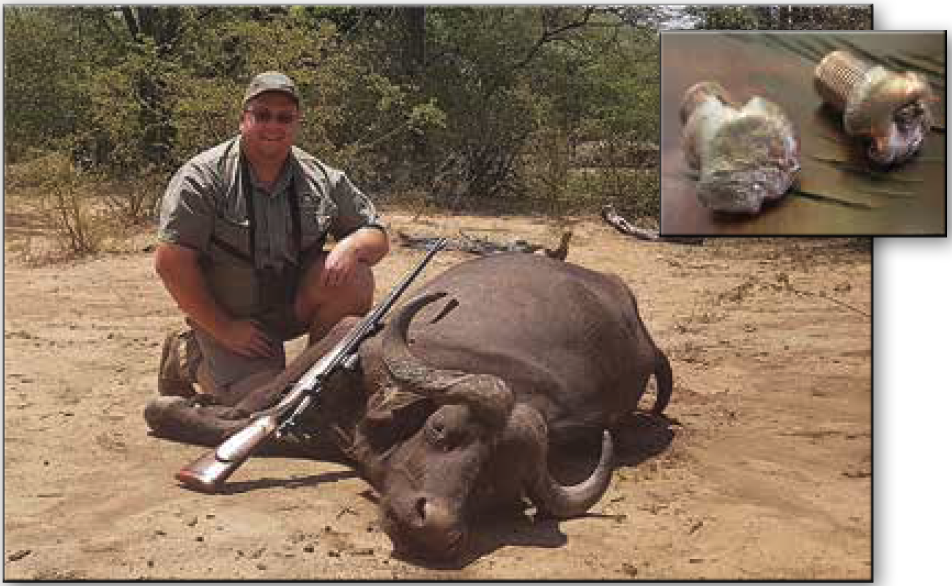
South African hunter, DEON BRITS, brought down this buffalo cow near the town of Hoedspruit in theLimpopo Province in South Africa. He used his custom-built .404 Jeffery, loaded with 400 gr Northfork SS bullets travelling ata speed of 2 270 feet per second.Shooting distance was 30 m, and the animal only managed to go 20 m after receiving two quick shots. With the buffalo standing quartering towards him, Deon aimed just inside the shoulder. Both bullets were recovered in the opposite flank underneath the skin. They weighed in at 356 gr and 344 gr respectively – a very good retention.
Contributions to “Where the Metal meets the Meat” are welcome. Please send picturesof your trophy animal and recovered bullet to hennie@africassportsman.com.