













The African Savanna Elephant
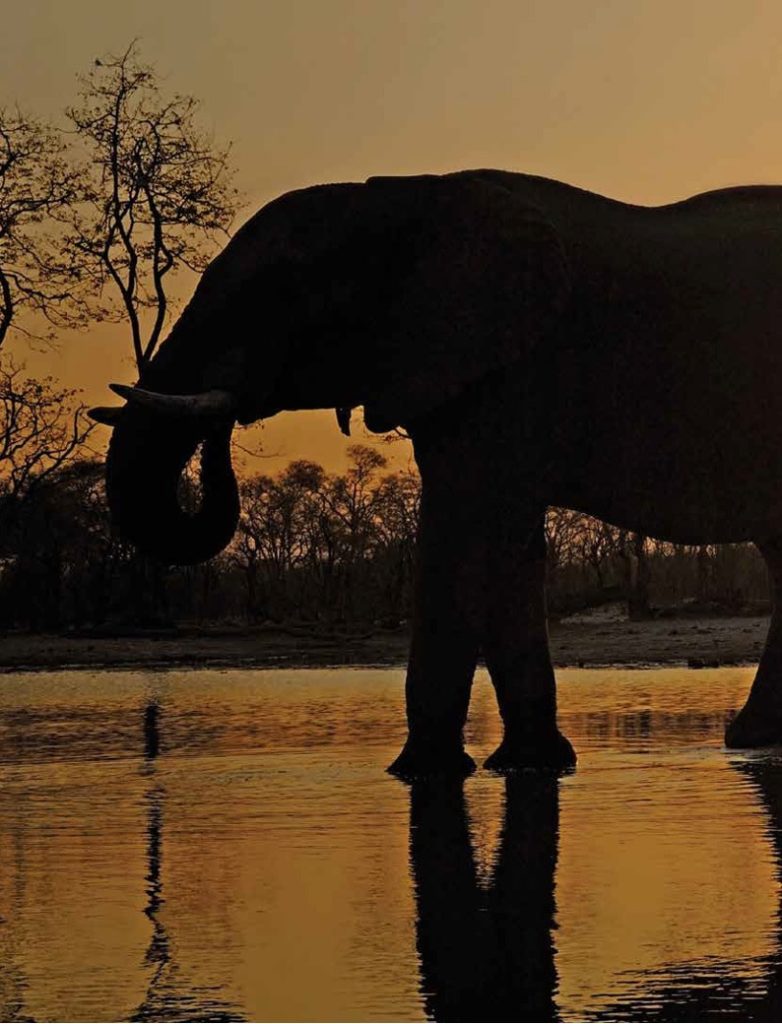
The African savanna elephant Loxodonta africana developed inAfrica some 1,5 million years ago and was first described scientificallyby Blumenbach in 1797 as Elephas africanus, based on a molar tooth from near the Orange River in South Africa.
The classification of the elephants is still debated by scientists but those that live now are the last‘remnants’ of the ‘order’ Proboscidea that could have contained numerous species in fivefamilies. The family Elephantidae includes the modern elephants, two species of mammoth, the imperial mammoth and the woolly mammoth. Currently, only the Asiatic elephant Elephas maximus, the African forest elephant Loxodonta cyclotis and the African savanna elephant Loxodonta africana have survived. However, provisional genetic research has indicated thepossibility of a third species of African elephant in the deep forests of western Africa.
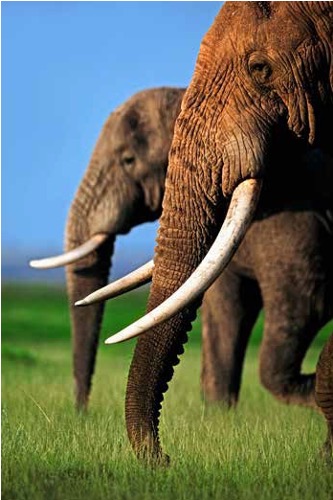
The trunkless Moeritherium contained several species and looked like a cross between a tapir and a hippopotamus. It lived in wetlands in the Al Fayoum Swamp west of the Nile River and south of Cairo in Egypt some 50 million years ago. It may later have given rise to several elephant families that spread over the world with the exception of Australia and some islands. The fossil elephant genus Stegodon could once have been the dominant type of elephant in Africa,and the genus Elephas originated south of the Sahara some six million years ago. Its fossils have been found in South Africa.
The African savanna elephant Loxodonta africana developed in Africa some 1,5 million years ago and was first described scientifically by Blumenbach in 1797 as Elephas africanus, based on a molar tooth from near the Orange River in South Africa. The name Loxodonta was created by an unknown scientist who Latinised Cuvier’s original name of Loxodonte for this species.
This name is derived from the ancient Greek words loxós for ‘slanting’ and odoús for ‘tooth’.
DESCRIPTION
A bull typically has a shoulder height of 3,42 m and weighs 5 500 to 6 000 kg as opposed to 2,62 m and 4 000 kg in a cow, but some bulls may be heavier. The largest known elephant that was shot by Josef J Fenykovi along the Cuando River in Angola in 1955, had a shoulder height of 4 m and a front foot circumference of 316 cm. It was stuffed and is displayed in the Smithsonian Institution in Washington, DC.
The tracks of the forefeet are larger and more rounded than those of the hind ones and the creased soles identify individual elephants. The weight of a bull increases throughout his life but that of a cow remains constant after an age of 35 to 40 years. The testes are abdominal and are not externally visible. The grey to brown-grey skin is thinnest behind theears and thickest on the trunk, forehead, legs and back. The body is covered sparsely with bristle-like hair and the cylindrical tail of some 1,5 m has a flat end with a tassel of long, black hair. The ear flaps may form 20 per cent of the skin surface and releases 75 per cent of the body heat.
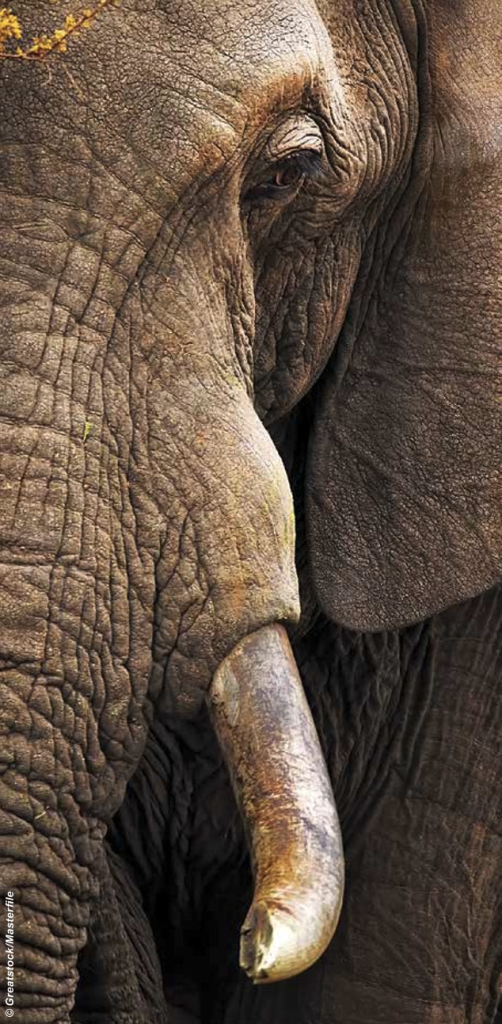
There are no sweat glands on the skin and two temporal glands on the side of the face increasingly secrete fluid whenan elephant experiences stress or a bull becomes sexually active. The trunk has prehensile tips on the bottom and top, consists of hundreds of muscles and has a multitude of uses. The cow has two teats between the forelegs. Age determination can be done by the wear of the six molar teeth which erupt in sequence, with each successive molar beingwider than its predecessor. The last molar appears at an age of 45 years and usually is worn away at an age of 60 to 70 years. The small eyes are green or hazel in colour but theeyesight of an elephant is poor, although its hearing is acute. The tusks grow throughout life and are enlarged upper incisors, but both sexes can be tuskless.
DISTRIBUTION
In South Africa, Vasco da Gama first mentioned elephants at Mossel Bay in 1497. Their southernmost distribution,however, seems to have been near Tiervlei just west of Stellenbosch, and they were found between Cape Town and Saldanha Bay in 1652. They once occurred in Namaqualand and around the Orange River. In years of exceptional rainfall a few elephants moved south from Botswana into the south-western Kalahari, and were recorded just west of the Augrabies Falls in 1779 and north of Kuruman in 1812.
Elephants were once abundant in the forests of the Southern Cape, and a remnant population still occurs in the Knysnaforest. As early as 1544, ivory was exported from Mozambique. The peak ivory export from South Africa to Europe occurred from 1879 to 1883, most of it originating from the northern parts. There once were large herds in KwaZulu-Natal.
DNA and isotopes are used to determine the origin of the ivory in the forests of West Africa within 135 km. However, it is less accurate in the bushveld, although the elephants from the Kruger and Addo Elephant National Parks are similar but differ from those in the Etosha National Park in Namibia.
HABITAT
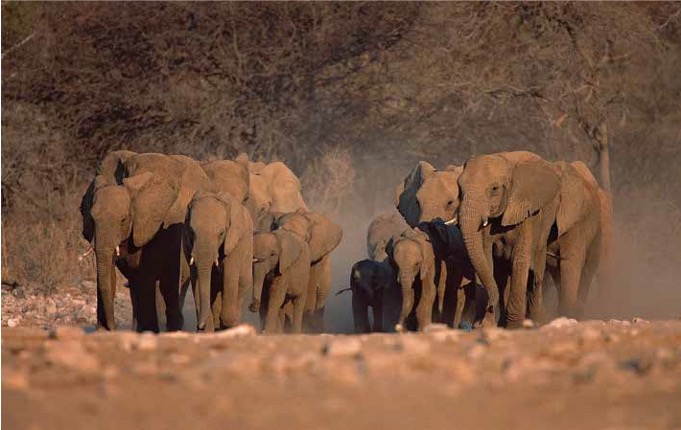
Elephants occur in habitats from deep forests to deserts, and water and food are their main requirements. In the arid Pre-Namib and Namib Desert the elephants have adapted their morphology and behaviour to cope with this harsh environment.
CHARACTERISTICS
Elephant cows form breeding herds that range over 5 527 km2 in northern Kenya. These herds are joined by bulls when the cows are in oestrus. Elephants swim well andcross shallow rivers with their trunks held above the water. They breed during the rainy summer season in the bushveld of Southern Africa. A bull starts to breed when he is 35 years old, and a cow when she is 25 old, depending on the quality of her food and her physical condition. Rutting bulls may become aggressive and secrete fluid copiously from their temporal glands while urine drips from the penis that becomes greenish.
The rut lasts from two to five months, in older bulls. A single calf is usually born after a gestation period of 22 months, although twins have been recorded. The cow gives birth in isolation but she may be protected by other cows. At birth the calf is some 0,9 m tall, weighs around 120 kg, is pinkish in colour and has more hair than an adult elephant. It suckles for two to three years but may continue to do so for up to eight years.
DIET AND WATER
Elephants eat a wide variety of roughage and wild fruits, depending on seasonal availability, and drink water regularly, mostly at midday. They eat the bark of some Acacia trees, use the bark of the baobab tree Adansonia digitata for its water content and uproot trees to eat the roots. In the wild, an elephant will eat 150 to 300 kg of plant material per day. Food use by elephants can change the composition of woody plants. They use 300 litres of water daily but waste some 140 litres to bathe. In the arid north-west of Namibia they drink every third day and use their forefeet and tusks to dig holes up to 80 cm deep for water in sandy river beds.
The dung is ideal for the germination of the seeds of certain trees, and wildlife eat undigested fruit seeds in elephant dung. The elephants of the African savannas require more time than the Asian elephants to eat.
Young elephants are preyed on by lions at times. The mean lifespan of an elephant is some 60 years.
MANAGEMENT AND UTILISATION
Free-ranging elephants should only be re-established in large areas, such as conservancies. On wildlife ranches their numbers should be limited by contraception.
Entire herds containing a dominant cow and a breeding bull with a shoulder height of at least 2,6 m should be established at the start or end of the wet season at a ratio of six adult cows per bull. The number of adult bulls shouldbe limited because excess bulls will attempt to break out, or there will be fights within and between the genders when the cows enter oestrus. The minimum herd size is determined by social, ecological, genetic and economic factors, but at least 50 animals are required to prevent inbreeding.
Elephants that break out can cause extensive problems and all fences must be electrified, with the top electrified strand 1,8 to 2,0 m high and 450 mm away from an elephant-proof fence. Every elephant has its own temperament and those that are nervous and aggressive in a boma should not be released.
Capture and transportation
Elephants can be captured chemically with A3080 and tranquillised with azaperone but only by a trained veterinarian. They should not be captured when the ambient temperature is more than 25 0C because they will overheat as they cannot flap their ears when immobilised. They must be cooled down with water after capture, especially behind the ears. An elephant’s lungs are attached to its chest cavity and diaphragm and it does not have a pleural cavity. Therefore it breathes by expanding and contracting its chest muscles to increase and reduce the chest cavity. It is vital to push an immobilised elephant lying on its chest onto its side to prevent it from suffocating within minutes after capture. Place a hat or soft cloth over the eye to protect it against dust and the sun, and stretch the trunk out while ensuring that its tip does not lie in dust or water.
Family groups can be transported in modified shipping containers with straw as bedding to absorb urine. Differentfamily groups should not be mixed and bulls must be transported alone. Provide water on trips that last longer than 12 hours. An overdose of a tranquilliser will cause and elephant to lie down during transport and die.
Temporary captivity
Elephants that are captured in winter must first be kept in a temporary boma of 1 ha before being released under long-term tranquillisation. Feeding can be done with a ration that does not contain more than 36 per cent roughage. Lucerne, hay, horse cubes, carrots, cabbage, guavas, citrusfruits, rock salt and fresh leaves can be fed but avocado pears should be avoided because they contain a heart toxin that can be fatal to an elephant. Fresh water must always be available.
Stocking density
Based on weight, an elephant is equivalentto 9,75 Browser or Grazer Units, but based on diet, it is equivalent to 7,02 Browser and 2,73 Grazer Units. Rainfall determines the ecological capacity of a region forelephants.
Meat and live sales
The meat of an elephant is fit for human consumption and excess meat following trophy hunting can be distributed amongrural communities. Elephants are not sold on live wildlife auctions.
Trophy hunting
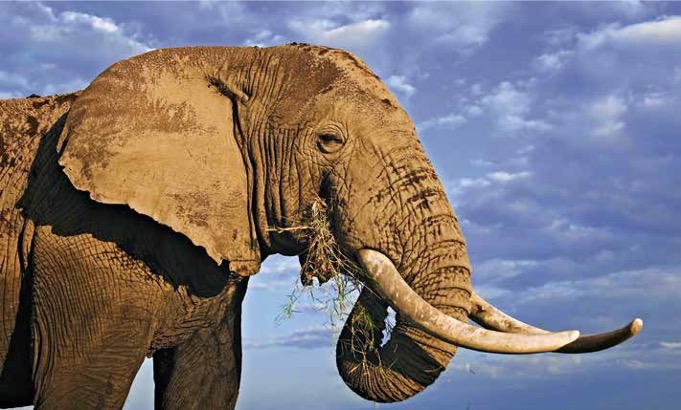
The heaviest pair of tusks on record camefrom Mount Kilimanjaro in Tanzania and weighed 102,7 and 97,0 kg respectively, but both were 3,1 m long. The heaviest pair onrecord from the Kruger National Park weighed73,5 and 69,0 kg respectively and came from near Skukuza.
Rowland Ward: Minimum weight: 80,000 pounds (36,36 kg); best: 226,000 pounds (102,727 kg) and lodged in the BritishMuseum of Natural History since 1878.
Safari Club International: Minimum: 100points; best: 302,000 points, held by Marc Pechenart. South African Method: Minimumweight (bull): 50,000 pounds (22,727 kg); best: 109,09 pounds (49,59 kg), held by G Guillaume. ASM
SELECTED SOURCES
Du Toit, JG. 2016. The African savanna elephant. In Jdu P Bothma & JG du Toit (Eds), Game ranchmanagement, sixth edition. Pretoria: Van Schaik, pp 232–244.
Garaï, ME. 2005. The elephant. In Bothma, J du P &
N van Rooyen (Eds), Intensive wildlife production in southern Africa. Pretoria: Van Schaik, pp 2–24. Preller, B. 2015. The silent giants of southern Africa, third edition. Bela-Bela: Bob Preller.
Skinner, JD & Chimimba, CT (Eds). 2005. Mammals of the southern African subregion, third edition. Cambridge: Cambridge University Press, pp 51–59.